You broke up months ago. Maybe even years ago. But something about that person still lives inside your head. Their voice plays on repeat. Their opinion shapes your choices. And no matter how hard you try, you can’t fully let go.
That’s not just missing someone. It might be a psychological sign of a soul tie — a deep mental bond that changes how you think, feel, and even see yourself.
Most people focus on the emotional or spiritual side. But soul ties also leave clear marks on your psychology. They change your thought patterns, your self-image, and the way your brain processes attachment. This guide digs into the mental and cognitive signs that most people miss.
If you’ve already explored the general signs of soul ties or the emotional signs of soul ties, this article goes deeper into the psychology behind the bond.
What Is a Soul Tie From a Psychological Perspective?
A soul tie is often described as a spiritual connection. But from a psychological standpoint, it’s a deep attachment bond that gets wired into your brain through intense shared experiences.
When you go through something powerful with another person, deep intimacy, emotional vulnerability, shared trauma, or even extreme conflict, your brain creates strong neural pathways linked to that person. These pathways connect to your reward system, your fear response, and your sense of identity.
That’s why a soul tie feels so different from a regular crush or even a close friendship. It’s not just fondness. It’s a bond that your brain treats as essential — almost like a survival need.
The Neuroscience Behind the Bond
Your brain releases oxytocin and dopamine during moments of deep connection. Over time, these chemicals create a feedback loop. Your mind starts to crave that person the way it craves food or safety.
When the bond is disrupted — through a breakup, distance, or betrayal — the brain responds similarly to withdrawal. This explains the obsessive thoughts, the panic, and the feeling that a part of you is missing.
13 Psychological Signs of a Soul Tie
1. Intrusive Thoughts That Won’t Stop
You’re at work, with friends, or trying to sleep — and their face pops into your head. Not in a sweet, nostalgic way. In a way that feels involuntary. You didn’t choose to think about them. Your brain just goes there on its own.
Intrusive thoughts about a person are one of the clearest psychological signs of a soul tie. These aren’t memories you revisit by choice. They’re mental loops your brain plays automatically, often triggered by tiny cues you don’t even notice.
2. Cognitive Dissonance When Trying to Leave
You know the relationship is unhealthy. You can list every red flag. But when you try to walk away, your brain fights you. It pulls up the good memories, makes excuses, and creates doubt about your decision.
This is cognitive dissonance — holding two conflicting beliefs at the same time. With a soul tie, it sounds like: “I know they hurt me, but I also feel like I can’t live without them.” It’s mentally exhausting and keeps people stuck for years.
3. Identity Fusion — Losing Yourself in Them
You used to have clear opinions, hobbies, and goals. But somewhere along the way, your identity started merging with theirs. You adopted their views. You dropped your interests. Now you’re not sure who you are without them.
Psychologists call this identity fusion. It goes beyond normal compromise. In a soul tie, the boundary between “me” and “them” dissolves. You start to feel like half a person — incomplete on your own.
4. Hypervigilance Around Their Mood
You constantly scan their tone, their body language, their texts for clues about how they feel. Not because you’re curious — because your nervous system is on high alert. Their mood directly controls your mood.
This hypervigilance often develops when the soul tie forms through unpredictable dynamics, hot-and-cold behavior, love bombing followed by withdrawal, or emotional volatility. Your brain learns to monitor them as a survival strategy.
5. Difficulty Making Decisions Without Them
Even after the relationship ends, you catch yourself wondering what they’d think. Should you take that job? Wear that outfit? Move to a new city? Their imagined opinion still carries weight.
This sign reveals how deeply the soul tie has infiltrated your executive functioning, the part of your brain responsible for judgment and planning. When someone’s influence is that deep, it takes deliberate work to reclaim your autonomy.
6. Emotional Flashbacks Triggered by Random Cues
A song comes on. You smell a certain cologne. You pass a restaurant you used to go to. And suddenly, it hits you — a wave of emotion so strong it feels like you’re back there.
These aren’t just memories. They’re emotional flashbacks. Your amygdala stores emotional experiences separately from your logical brain. A soul tie creates so many intense emotional moments that your trigger list becomes enormous.
7. Rumination — Replaying Conversations Over and Over
You replay the argument. You rewrite your response. You imagine what you should have said. Then you do it all over again. This kind of mental looping is called rumination, and it’s a hallmark of psychological soul ties.
Rumination keeps the bond alive in your mind even when it’s dead in reality. It tricks your brain into thinking the situation is still happening — which is why your body keeps producing stress hormones long after the relationship ended.
8. Black-and-White Thinking About the Person
One minute, they’re the best thing that ever happened to you. Next, they’re a monster. You swing between idealizing them and demonizing them without much middle ground.
This splitting pattern is common in intense attachment bonds. Your brain struggles to hold a balanced view because the relationship produced such extreme highs and lows. A soul tie thrives in this all-or-nothing mental space.
9. Comparing Everyone to Them
New people enter your life, but nobody measures up. Not because the new people are bad, but because your brain has created an idealized template based on the soul-tied person. Everyone else falls short of the standard your mind built.
This comparison pattern can sabotage new relationships for years. It’s not about loyalty. It’s about the psychological imprint the soul tie left on your brain’s reward circuitry.
10. Anxiety Spikes When You Consider Moving On
The idea of fully letting go doesn’t bring relief. It brings panic. Your chest tightens. Your thoughts race. You feel guilty, scared, or even physically ill.
This anxiety response happens because your brain has linked that person to your sense of safety. Moving on feels threatening — not just sad. It’s one of the strongest psychological signs that a soul tie has embedded itself in your attachment system.
11. Selective Memory — Only Remembering the Good
Your brain edits the past. It softens the fights, erases the tears, and highlights the laughter. When you look back, the relationship seems almost perfect — even though you know it wasn’t.
This is rosy retrospection, and soul ties amplify it. The emotional intensity of the bond makes the positive moments feel larger than life, while the painful ones get filed away. It’s your brain’s way of justifying the attachment.
12. Feeling Like Part of You Is Missing
After the bond breaks, there’s an emptiness that doesn’t go away. Not regular sadness. A feeling like an actual piece of your identity was removed. You feel incomplete, hollow, smaller than you used to be.
This happens because a psychological soul tie literally rewires how you see yourself. You defined yourself in relation to that person. When they’re gone, the self-concept you built around them collapses, and rebuilding it takes time.
13. Dreams and Subconscious Preoccupation
They show up in your dreams regularly. Not just once in a while — but often enough that your waking mind can’t escape them either. You wake up thinking about them, emotionally charged by a conversation that only happened in your sleep.
Dream content is driven by unresolved psychological material. A soul tie keeps feeding your subconscious with unfinished emotional business. Until the underlying attachment is addressed, your dreaming mind will continue to process it.
Why Do Psychological Soul Ties Form?
Not every deep connection becomes a soul tie. Certain conditions make the bond more likely to take root in your psychology:
- Childhood attachment wounds: If you grew up with inconsistent love, your brain is primed to form intense bonds with people who replicate that pattern.
- Physical intimacy: Sex releases powerful bonding chemicals. When combined with emotional vulnerability, it creates a potent cocktail for soul tie formation.
- Shared trauma: Going through crisis together — grief, illness, hardship — creates a bond that feels unbreakable because it was forged under stress.
- Intermittent reinforcement: Hot-and-cold dynamics are psychologically addictive. The unpredictability trains your brain to fixate on the person, waiting for the next “reward.”
- First love or formative relationships: Your first deep relationship builds a template in your brain. It shapes what love “feels like” to you — and that template can persist for life.
Soul Tie vs. Trauma Bond vs. Limerence: What’s the Difference?
These terms often get mixed up. Here’s how they differ:
| Feature | Soul Tie | Trauma Bond | Limerence |
|---|---|---|---|
| Root cause | Deep emotional or spiritual connection | Cycles of abuse and intermittent kindness | Obsessive romantic infatuation |
| Can it be healthy? | Yes | No | Rarely |
| Key feeling | Deep pull, a sense of missing a part of yourself | Fear of leaving, walking on eggshells | Intense craving for reciprocation |
| Main psych pattern | Identity fusion, cognitive dissonance | Learned helplessness, Stockholm syndrome | Intrusive fantasies, mood dependency |
| Does it require the other person? | No — can persist one-sided | Yes — needs ongoing contact | No — often one-sided |
How Soul Ties Affect Your Mental Health
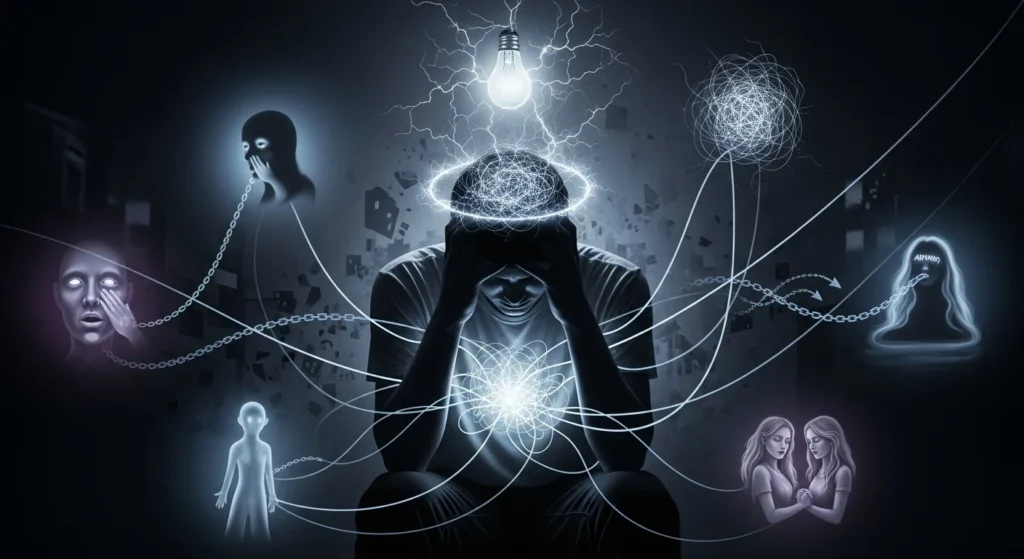
A soul tie isn’t just a relationship concept. When it’s unhealthy, it can create real psychological consequences:
Anxiety and Hyperarousal
Your nervous system stays activated. You check your phone constantly, overanalyze interactions, and feel on edge even in calm moments. The soul tie keeps your fight-or-flight system running in the background.
Depression and Grief
Losing a soul-tied person can feel like a death — even if they’re still alive. The grief is disproportionate because the bond was disproportionately deep. You may experience numbness, loss of motivation, and withdrawal from things you used to enjoy.
Obsessive-Compulsive Patterns
Some people develop OCD-like patterns around a soul tie: checking social media compulsively, needing reassurance, or performing mental rituals (like replaying conversations to “figure out” what went wrong). These behaviors temporarily reduce anxiety but reinforce the obsessive loop.
Self-Esteem Erosion
A toxic soul tie slowly convinces you that you’re not enough on your own. You may start to believe that your worth depends on this person’s love, attention, or approval. Over time, your self-concept shrinks to fit the role the relationship defined for you.
How to Break a Psychological Soul Tie: A Step-by-Step Guide
Breaking a soul tie isn’t about forgetting someone. It’s about reclaiming your mental freedom. Here’s how to start:
Step 1: Name the Bond
Acknowledge what’s happening. Say it out loud or write it down: “I have a soul tie with this person, and it’s affecting my mental health.” Naming the pattern is the first step to changing it.
Step 2: Identify Your Triggers
Make a list of what activates the bond. Songs, places, social media, mutual friends, certain times of day. Once you know your triggers, you can start managing them instead of being controlled by them.
Step 3: Challenge Distorted Thoughts
When your brain says, “You’ll never find someone like them,” challenge it. Is that true? Or is that the soul tie talking? Cognitive behavioral techniques help you separate facts from feelings.
Step 4: Set Hard Boundaries
Go no-contact if possible. Unfollow, mute, block — whatever you need to stop feeding the neural pathways. Every interaction reinforces the bond. Starving it of input is how it weakens.
Step 5: Rebuild Your Identity
Reconnect with who you were before this person. What did you like? What were your goals? What mattered to you? Start small — pick up an old hobby, revisit a forgotten dream, spend time with people who knew you before the relationship.
Step 6: Work With a Professional
A therapist trained in attachment theory, EMDR, or trauma recovery can help you process the bond at a deeper level. Soul ties often have roots in early attachment wounds — and those need professional care.
Step 7: Be Patient With Yourself
Breaking a psychological soul tie isn’t instant. The neural pathways took time to form, and they’ll take time to weaken. Setbacks are normal. Healing isn’t linear. What matters is that you keep choosing yourself.
Frequently Asked Questions
What are the psychological signs of a soul tie?
They include intrusive thoughts, cognitive dissonance, identity fusion, hypervigilance, difficulty making decisions alone, emotional flashbacks, rumination, black-and-white thinking, constant comparison, anxiety about moving on, selective memory, a sense of incompleteness, and recurring dreams about the person.
Can soul ties cause mental health problems?
Yes. Unhealthy soul ties can trigger anxiety, depression, obsessive thinking, low self-esteem, and trauma-like symptoms — especially when the bond is formed through manipulation or unpredictable dynamics.
What’s the difference between a soul tie and trauma bonding?
A soul tie can be healthy or unhealthy. Trauma bonding forms specifically through abuse cycles. All trauma bonds involve unhealthy attachment, but not all soul ties are trauma bonds.
How do you break a psychological soul tie?
Name the bond, identify triggers, challenge distorted thoughts, go no-contact, rebuild your identity, and work with a therapist if needed. Healing takes time and patience.
Can a soul tie affect you years later?
Absolutely. Deep emotional bonds are stored in long-term memory. A scent, a song, or a place can reactivate those neural pathways even decades after the relationship ended.
Is a soul tie the same as codependency?
They’re related but different. Codependency is a behavioral pattern of needing someone to feel okay. A soul tie is a deeper bond. A soul tie can lead to codependency, but not all codependent relationships involve soul ties.
Final Thoughts
A soul tie isn’t just something you feel in your heart. It shows up in your thoughts, your decisions, your sense of self, and the way your brain processes the world. Recognizing the psychological signs is the first step toward freedom.
You’re not broken for feeling this way. Your brain formed a deep bond because intense things happened. But bonds can be rewired. Patterns can be changed. And you deserve to think your own thoughts again.